Pittsburgh:
Mayor Peduto proposes real estate ta hike to fill projected $35 million budget shortfall.
Who are Pittsburgh's best professors? (Pittsburgh Magazine)
Ed Piskor is Pittsburgh's Hip-Hop historian (Pittsburgh Magazine)
Chicago blogger rallies in defense of a bikeable Pittsburgh (Pop City)
Pittsburgh Public Market hosts first-ever food swap. (Pop City) .
Cleveland:
There's a reason you're hearing so much about Cleveland these days (Next City)
Cleveland State University president to move downtown, becomes first CSU head to not live in Shaker Heights. (Cleveland Scene)
Bach, Boulez and ballet highlight new Cleveland Orchestra season.
Cincinnati
How Cincinnati's pro-streetcar campaigners won in the end. (Atlantic/ Citylab)
West Virginia
Barbara Hicks Lacey remembers Charleston during segregation. (West Virginia Public Radio)
West Virginia urged to fight for international tourists
Twelve West Virginia communities focus on abandoned and blighted properties
Other Urbanism News.
Strange cloud over St. Louis turns out to be a huge swarm of butterflies. (Atlantic/Citylab)
Want to see more Millennials as home owners? Ease FHA condo restrictions. (Next City)
The Pink Zone: Why Detroit is the new Brooklyn (Fortune Magazine)
Placemaking and street design for conservatives (Urbanism Speakeasy)
If so many people support mass transit, why do so few ride? (Atlantic/ Citylab)
Walking through the art of black radical Brooklyn (Next City)
Why cities should strive for streets that "fail" (Streetsblog)
Private owner of Indiana Turnpike files or bankruptcy
Bi-partisan Senate bill would give locals more control of transportation spending. (Streetsblog)
Art News:
Hyperallergic talks with longtime Pittsburgh based artist, Christopher Kardambikis @ The New York Art Book Fair. (Hyperallergic)
Do Mexican drug lords buy art? (Hyperallergic)
The esoteric world of print collecting (The New York Times)
Great piece on museum and gallery no-photo policies (Business Insider AU)
In London,showcases for self-taught artist's works (Hyperallergic)
Unfinished work by Leonardo nearly restored. (The Art Newspaper)
Fashion photography is the art world's rising star (The New York Times)
Paleolithic art at Spanish, Altamira Caves to remain open until February 2015 (The Art Newspaper)
Two new Mayan cities discovered in Mexico's Yucatan Peninsula. (The Art Newspaper)
Banned Books week: Comic books and literary censorship. (Reason Magazine)
Banned Books Week: Guess which book topped the list again? (Reason Magazine)
Showing posts with label Detroit. Show all posts
Showing posts with label Detroit. Show all posts
Wednesday, September 24, 2014


Saturday, April 14, 2012
Private bus line aims to fill the gaps in Detroit's failing transit system
Public safety, transit among $160 million in cuts in Detroit budget proposal
On top of earlier cuts
Slowly private business people are wondering if they can serve this market.
From The Detroit News
The obvious need for the service is so great and the current system so bad, few politicians are complaining.
We have to get away from the idea that the failure of top down, poorly run government transit automatically means the death of transit service.
On top of earlier cuts
Slowly private business people are wondering if they can serve this market.
From The Detroit News
Didorosi's first bus will launch the last week of April, and the other two will follow. Didorosi said he wants to quickly expand to day service after starting with a schedule that runs from 5 p.m. to midnight Mondays and Tuesdays, and 5 p.m. to 2:30 a.m. Wednesdays through Sundays.
Didorosi said he plans to base routes on public bus lines and market research. A day pass will cost $5 even as gas prices sit above $4 a gallon.
The obvious need for the service is so great and the current system so bad, few politicians are complaining.
Didorosi said longtime promises of more efficient bus systems and light rail are going nowhere.
"In the now, there's nothing. It's impossible to get around downtown," Didorosi said.
We have to get away from the idea that the failure of top down, poorly run government transit automatically means the death of transit service.
Thursday, March 29, 2012
New Regional Art Site, Art Hopper seeks writers
This comment was left on my post about Art Hopper by one of the site founders.
Contact here if interested.
FYI, folks in and around Buffalo, that includes you!
Thank your for highlighting the new site. Arthopper launched on January 1, 2012. The similarity to Glasstire is not an accident. I went to graduate school in San Antonio, love Glasstire, and wanted to recreate the experience here.
Any any all suggestions, comments and criticisms are welcome and encouraged. We want the site to work for all and to be a real community asset.
Buffalo is on the list of cities to add but we cannot do it all at once. If you know writers who are interested in submitting content please have them contact me. We are a volunteer effort now but will me moving toward a paid "society of correspondents."
Rick, I enjoy your work in Pittsburgh and hope we are able to collaborate.
John, we would welcome opinion pieces from you as well as important arts issues pieces.
Jimmy Kuehnle
Founder
Arthopper.org
Contact here if interested.
FYI, folks in and around Buffalo, that includes you!
Friday, April 01, 2011
Famous/Infamous Michigan Sprawl Letter and Discussion On Rustwire
My personal "mission" on this blog was not just to hype the local art scene in Pittsburgh itself, but also spark awareness, debate across the wider region about ways to create and sustain a better quality of life. The former Rust Belt, is filled with areas that are spreading out dramatically, even as their populations shrink.
Michigan is pretty far, but a letter from a figure at a successful law firm that operates there has gone viral, triggering, I hope some relevant conversation.
The letter's specific topic deals with what the writer sees as the negative effects of suburban sprawl on the firm's business outlook and ability to recruit and retain employees.
The letter which was originally addressed to the city leaders of Troy Michigan goes pretty far in depth.
Also, the author helped create this video, offering the start of a tangible plan to better organise and link Detroit and it's northern suburbs through light rail.
One thing I like about both is that they go far beyond just denying the suburbs and smaller towns and cities exist and demanding that everyone move back into Detroit. As the video shows, some of these places have long and unique histories, beautiful buildings and even sound original street designs dating from the pre auto age. Many also happen to line up along a corridor making it possible to connect them with a single rail link.
James Howard Kunstler dedicated an entire podcast to the sprawl letter.
Michigan is pretty far, but a letter from a figure at a successful law firm that operates there has gone viral, triggering, I hope some relevant conversation.
The letter's specific topic deals with what the writer sees as the negative effects of suburban sprawl on the firm's business outlook and ability to recruit and retain employees.
Recession or no, isn’t it screamingly obvious that people with choices in life – i.e. people with money and education – choose not to live here? We are becoming a place where people without resources are grudgingly forced to live. A place without youth, prospects, respect, money or influence.
There’s a simple reason why many people don’t want to live here: it’s an unpleasant place because most of it is visually unattractive and because it is lacking in quality living options other than tract suburbia. Some might call this poor “quality of life.” A better term might be poor “quality of place.” In Metro Detroit, we have built a very bad physical place. We don’t have charming, vibrant cities and we don’t have open space.
The letter which was originally addressed to the city leaders of Troy Michigan goes pretty far in depth.
Also, the author helped create this video, offering the start of a tangible plan to better organise and link Detroit and it's northern suburbs through light rail.
One thing I like about both is that they go far beyond just denying the suburbs and smaller towns and cities exist and demanding that everyone move back into Detroit. As the video shows, some of these places have long and unique histories, beautiful buildings and even sound original street designs dating from the pre auto age. Many also happen to line up along a corridor making it possible to connect them with a single rail link.
James Howard Kunstler dedicated an entire podcast to the sprawl letter.
Monday, November 22, 2010
Detroit's Heidelberg Project

Yesterday I got a brief tour of Detroit, courtesy of an old friend who lives in Ann Arbor and teaches in Flint. The trip was too short for me to really wrap my mind around Detroit as a whole--I did notice how spread out it was, but I didn't always get a sense of what part of this was just a wider-scale city planning or a car-centered urban vision vs. Rust Belt depopulation. Until we went seeking Heidelberg Street. As soon as we turned off Jefferson Avenue and entered the neighborhood of McDougall-Hunt, I could see the Detroit I'd heard about: the abandoned and half-burnt houses, the many empty lots where houses used to be, no evidence of any grocery stores, and some evidence of urban gardening.

Then we reached The Heidelberg Project. Due to my longtime East Coast chauvinism no doubt, I had never heard of this amazing outsider-artist, two-block-wide "installation," although it has been around since 1986--growing, evolving, getting demolished by Detroit police, and growing back again like unstoppable knotweed. One Detroit resident, Tyree Guyton, grew up on Heidelberg Street and witnessed the 1968 riots, from which he says Detroit has never recovered. After he began cleaning up the debris in empty lots and abandoned houses on his block, he started to create art by decorating the empty houses with the trashed items he'd found. The result is colorful, beautiful, and critical, and seems to succeed in getting attention for the plight of the neighborhood and the city--and Detroit's efforts to rally around creative community engagement. While we walked around, we overheard one of the street's residents explaining the project to a visitor, and saw foreign tourists stopping to shoot pictures and wander among the houses, the sculptures, and the makeshift billboards. We met an artist, Lisa Marie Rodriguez, who is an artist-in-residence at the Heidelberg, studying at Wayne State U. She's been working on an entranceway to the block and has constructed a welcome sign, a sun dial, and a meditation garden. She knew all the neighborhood residents who passed by and told us that the community wants to see not only that they get attention, but that someone sticks around and cares about the continued progress of the neighborhood. She considers herself an artist in residence for the long run.
This project is best described in images; see more pictures here.

Saturday, March 06, 2010
Detroit Shrinks To Survive (Or Thinks About It)
Sorry, once again for not posting more--it's not that there isn't news, in fact I'm overwhelmed with things we should be thinking and talking about.
When I made my post about the snow, I meant to do a follow up delving into the issue it opened up. Are all people entitled to the same level of government funded infrastructure, schools, roads, snow plowing, transit etc... no matter where they choose to live--or is it reasonable for a city to limit services and use prudent cost benefit judgments to focus money on places where it would be most productive? Should it charge according to cost? Believe it or not, in places like Hong Kong and Singapore, transit either breaks even, or is operated by a company with real estate interests along the line.
Infrastructure, is the great unspoken entitlement program, so embedded in our culture few ever think about it.
Detroit, never ever thought about these things. All people were entitled to live anywhere they pleased regardless of cost and as the city shrank, tax dollars by default flowed towards the areas of greatest "need". The final result, was a regional population spreading out and shrinking at the same time. Detroit's land area today could hold all of Boston + all of San Francisco + all of Manhattan and a nice chunk of some other city and still have room.
Boston Population 620,535 ('08 estimate) Land Area 48.43 sq mi
San Francisco Population 808,976 Land Area 46.7 sq mi
Manhattan Population 1,634,795 Land Area 33.77 sq mi (area includes bulk of NY regions good jobs)
Detroit Population 912,062 (estimated to now not be much over 800,000) Land Area 138.8 sq mi
Finally, the city and entire state of Michigan are beyond broke and beyond temporary bailouts or fixes. The subject is on the table in a big way.
"Bing's (Detroit mayor) staff is using its own data and a survey released last weekend by Data Driven Detroit. The block-by-block study of the 139 square-mile city showed that roughly one in three parcels are vacant lots or abandoned homes. The mayor's staff didn't elaborate on Bing's comments to WJR beyond a statement saying, "the mayor will utilize data from several sources including city departments, Data Driven Detroit, as well resident input, to prepare a viable land use plan."
Steven Ogden, executive director of Next Detroit Neighborhood Initiative, is using the group's data to come up with a plan for which neighborhoods his nonprofit should target in the next several years with time and money. He submitted a proposal to the Bing administration within the past several days on what areas he wants to partner with the city to target."
I don't have time or details on this. It's pretty clear using force to physically remove people from their homes and neighborhoods is wrong and not likely to be possible on a large scale. (even though the city has done this over and over in the past) Equally clear is that one way or another some type of triage in terms of providing city services will likely be made either now or in the future. Already, Detroit's utilities are making these choices and cutting more and more blocks off from power and gas.
An extreme example of issues many cities in the former rust belt are facing.
Related articles.
http://www.rethinkdetroit.org/2010/01/30/how-kresge-plans-to-reconfigure-detroit/
http://www.rethinkdetroit.org/2010/01/24/jane-jacobs-on-detroit-low-density-failure/
Monday, October 26, 2009
Corruption And The Rust Belt
Rust Wire asks what role corruption plays in depressing local economies. It refers to this 2007 piece by Transparency International.
"According to economist Sanjeev Gupta, national corruption lowers economic growth and per-capital income, despite the argument that a certain amount of corruption can “grease the wheels” of the economy by circumventing bureaucratic regulations.
“Corruption increases the cost of investment for entrepreneurs who need to devote their scarce time and resources to fulfilling government regulations and bribing officials,” Gupta writes. “This cost can be high for small and medium-sized enterprises.”
“Second, corruption acts as a barrier to foreign investment and results in the flight of capital out of a country. The use of public funds to acquire assets abroad shrinks the economy’s savings pool that could otherwise be used for investment. This has repercussions for future generations, particularly in resource-based economies.”"
While, the role of corruption, the lack of clear rules and transparent institutions is almost universally considered a big drag on developing countries, Few have the guts to say it might be one of the biggest factors depressing the "rust belt" and even fewer try to do much about it.
Yet another big public scandal in Cleveland repeats a common theme in places like Ohio and Michigan.
"Damiani, a close ally of County Auditor Frank Russo, orchestrated the arrangement in which his law firm had near-total control over V.A.S. Enterprises, the commercial real estate appraisal firm that got more than $21 million in contracts with the auditor's office over a decade, according to federal prosecutors. V.A.S. did only $9 million in work, according to an audit released last week.
One of Russo's top aides has admitted taking $154,000 in bribes and helping to funnel $1.2 million in kickbacks to Russo from the Damiani-connected firms. In return V.A.S was awarded contracts to perform commercial audits, according to charges and plea agreements."
The Transparency International story suggests that the costs of opaque and corrupt government may fall hardest on small business people who lack inside connections, or political power. Small business job loss is much harder to guess at than big business, but it's very, very bad.
Clearly, at least by what's currently known we are not in Cleveland's league, but let's just say that transparency isn't big here.
Friday, December 01, 2006
MOCAD --- In The New York Times

Detroit's new funky, raw and brutally honest museum of contemporary art got a nice article in the New York Times, which celebrates it's real deal aesthetic. MOCAD will gradually be upgrading and transforming the building over time.
"But the design springs from a profound rethinking of what constitutes urban revitalization. Designed by Andrew Zago, its intentionally raw aesthetic is conceived as an act of guerrilla architecture, one that accepts decay as fact rather than attempt to create a false vision of urban density. By embracing reality, it could succeed where large-scale development has so far failed.
Mr. Zago is uniquely positioned to grasp this context. Born in Detroit in 1958, he has vivid memories of the 1967 race riots that led the exodus of the white middle class. He remembers hearing white neighbors talk of fleeing to the suburbs as black families moved in. After departing with his family to a northern suburb, he saw the city decline to the point where it became a poster child of decay.
Only later, as a practicing architect in the 1990s, did he begin to see these decrepit neighborhoods as a legitimate landscape for architectural experimentation. “I didn’t want to romanticize it,” he said during a recent tour of Detroit, “but the city had a depth of character, a real substance and integrity. And while you want to do away with the problems, you don’t want to lose that quality.”
Saturday, October 14, 2006
Shrinking Cities
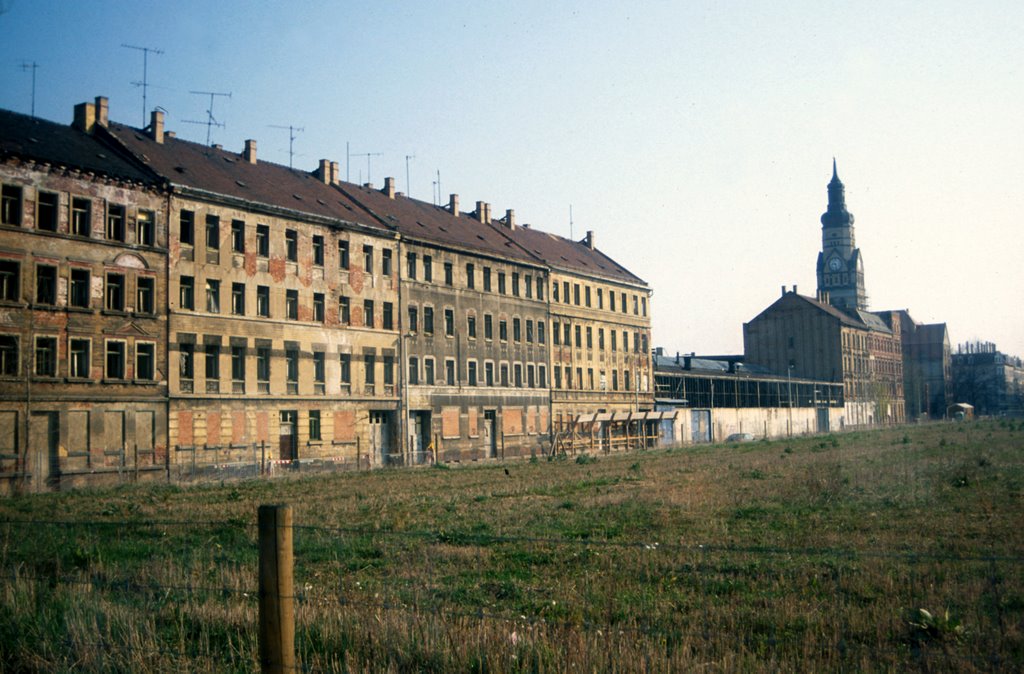 Leipzig
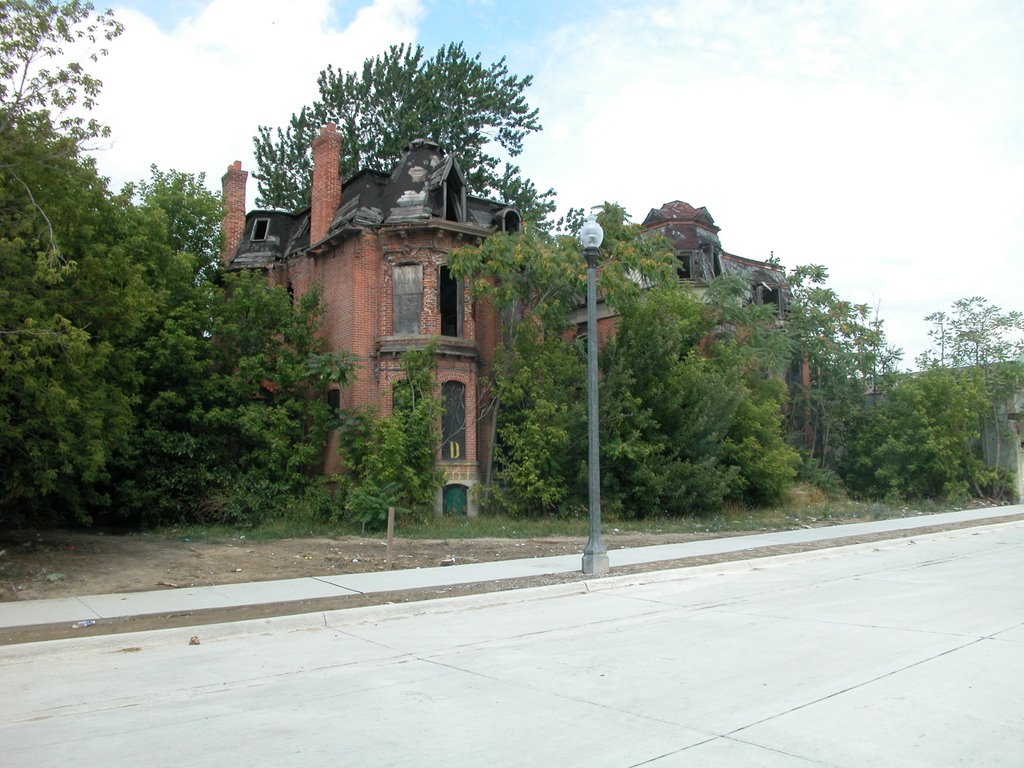 Detroit
 Detroit
I have to admit to just becoming aware of this facinating project called shrinking cities.
The project was started in Germany and I think that the first lines of the web intro imply that all cities are shrinking-- which is not close to being true and even the website has to slip that in.
(6.1 billion people currently live on the earth, 3 billion of them in cities. By 2030, the population of the world will have increased by 2 billion (+33%). This increase will be stem almost exclusively from the growth in urban population. Every day, 190,000 new city-dwellers are added all over the world, 2 in every second. In the year 2030, 4.9 billion people will live in cities)
The shrinking city is however an important area for study.
Intro from the Website:
The Project ///
Shrinking Cities, a three-year initiative project of Germany's Federal Cultural Foundation, seeks to expand Germany's city-planning debate - until now concentrated on questions of demolishing surplus apartments and improving residential quarters - to address new questions and perspectives. The project also places developments in eastern Germany in an international context, involving various artistic, design, and research disciplines in the search for strategies for action. The emphases of the research and exhibition project, Shrinking Cities, are, first, an international study of processes of shrinking (first project phase) and, second, the development of strategies for action for eastern Germany (second project phase).International Study /// Since 2002, four local interdisciplinary teams have been commissioned to study and document urban shrinking processes in the urban regions of Detroit (USA), Manchester/Liverpool (Britain), Ivanovo (Russia), and Halle/Leipzig (Germany). Each site stands as an example of a specific form of shrinking: In Detroit, the issue is the consequences of suburbanization; in Manchester/Liverpool, of deindustralization; in Ivanavo, of postsocialism; and in the greater Halle/Leipzig region, several of these factors are compounded. People from various disciplines, including urban geographers, cultural experts, architects, journalists, and artists, take part in the work.
The project has also developed a touring exhibition.
Friday, October 13, 2006
The City Of The Mind
My recent posts, posts, posts, on Detroit seem important on some deep level I cant explain fully. Pittsburgh and Detroit seem to have huge amount in common. It's not just that they were industrial cities; they were the birth places of huge industries and had built there identities so completly around them that they were the global symbols of those industries. No doubt the size of the industrial complexes made them look like permanent and unmoveable forces that could not be changed. Perhaps, unwisely people built thier lives as if they could not be moved or at least never killed.
Every city is the interaction between a real place and a mythology that people build around it and with these two places the interaction is traumatic. I think that my memories of NY in the late 70's were facing that interaction. On the one hand, you knew that NY was like the greatest city in the world and yet the day to day facts showed you it wasn't that great. But, what happened to places like Pittsburgh and even more so Detroit has to be on a totally different level. New York, somehow found it's greatness again ( to a large extent imigrants came who believed in it ) and for the most part, it never really faced becoming irrelavant. But, both Pittsburgh and Detroit have faced becoming footnotes or even in the case of Detroit epic symbols of America gone wrong.
The other major thing that links the cities is their huge diasporas. So anyway, I am hoping to here from some people in Detroit and people from Detroit and perhaps involve them in my diaspora project. I am particularly interested in hooking up with artist's from Detroit and those that live there now. Please pass this post along. I still am very much looking to develop build my links to the Pittsburgh diaspora.
Thursday, October 12, 2006
Museum Of Contemporary Art Detroit

Speakingof Detroit; I have been trying to follow the cities long struggle to create a contemporary art museum. Detroit Arts has a great recent post on the subject which links to a long article. It now sure looks like it's now more than a wet dream-- the place will be known as MOCAD.
Detroit Arts, seems to have developed a srappy and dedicated following, judging from the active comments.
Here's the start of the article:
"A year ago, when word got out about seemingly legitimate plans for a new contemporary art institution in Detroit, the buzz was big in the creative community. Many were skeptical from the first word — people here are skeptical about "new" anything.
But in the ensuing months, the e-mails arrived, followed up by press releases. There were a few stories in local papers, and then the Web site launched. Weeks ago, colorful stickers and posters came in the mail. It still seems hard to believe, unless you've recently seen the space that's to be the home of the Museum of Contemporary Art Detroit ( MOCAD) on the corner of Woodward Avenue and Garfield Street. You probably haven't noticed the unremarkable building, but it's been there since the 1930s, when it was an auto dealership. Located in Midtown, near the Cultural Center, the museum will be a short walk south from the Detroit Institute of Arts, Detroit Public Library, Detroit Artists Market, and north from CPop Gallery and the Max M. Fisher Music Center, home of the Detroit Symphony Orchestra.
I have come across an impressive array of blogs and web projects in the Detroit area. Many of them are poignant efforts to document the lost memories of the city and also to develop a new virtual identity.
Michele Zalopany at Esso
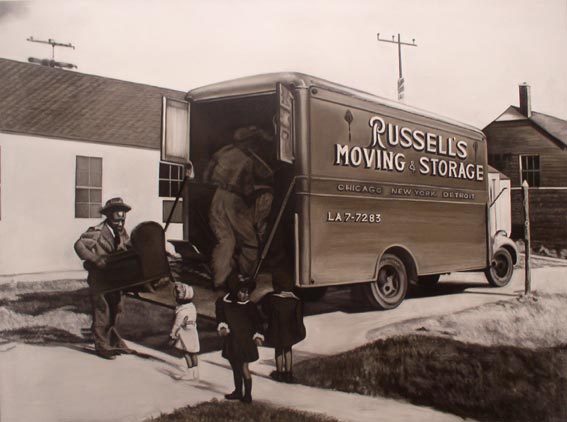
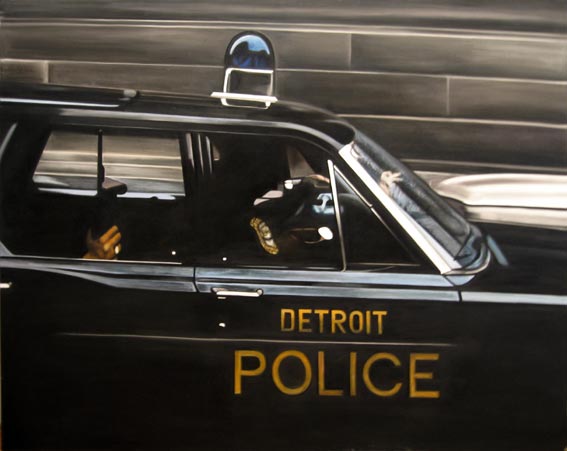
This is a show( with a nice review here ) in NY, that just ended by an artist originally from Detroit. I came across the show through James Wagner's post and while I did not see the show and have never been to Detroit ; I was very moved by this work. The artist is tapping into such a rich river of memory and identity, that gives the images a lot of power. These images are loaded.
From the gallery press release:
Her paintings' photographic realism use a fictitious model, closer to an excuse to raise a question rather than make a statement, although many of the places, people and things are, or were, real. In 1943 it is believed that a confrontation on the Belle Isle Bridge was the spark to the ensuing riots. Zalopany's beautiful rendering of the empty Belle Isle Bridge paradoxically describes the scene of social malaise and the inability to mitigate Detroit's enormous racial chasm.
Zalopany's larger-than-life "Line Up" comprised of three panels at a total of 7'4" x 13 ft is a meditation on profiling in 1943. The six subjects, three males and three females, are posed in a police line up, dressed as though they were going to church, stare ambivalently into the camera, hence, at the viewer, asking the question 'why?' The viewer is in front of a contradiction, a painting that is not just a painting leaves open every interpretation. The painter obviously wasn't sitting in front of six subjects in a police line up. Maybe she painted using models in vintage clothes, in order to balance the unpleasantness of the real image she pushed herself to compose another antithetical one. The presence or absence maybe doesn't means much, what matters is her ability to make each of her paintings a serious questions. Technically, each picture is born pastel stroke by pastel stroke - applied with great skill and experience as well as the necessity that brings the artist to create new forms for her language and to organize the invented forms in relationships, into image-making.
Subscribe to:
Posts (Atom)

 Posts


